


Workplace Banking, Simplified: A Better Path to Financial Health
Why financial pressure stops being one worker’s problem the moment it walks into HR, and how workplace banking solves this.
It is the 20th of the month. Payroll lands on the 28th. The HR manager at an East African BPO opens her inbox to the fourth salary advance request of the week. By Friday, it will be the seventh. She knows the names, the reasons, the patterns. School fees. A clinic visit. A funeral up-country.
Her job description does not include “informal lender to a 400-person workforce.” But here we are.
This is the everyday cost of financial pressure in Africa. It arrives in a queue- requests, approvals, WhatsApp messages to Finance and more paperwork. Multiply across a workforce and a year, and the strongest argument for workplace banking turns out not to be about banking at all. It is about what happens to organisations and the people inside them when access to money breaks down.
The numbers
The 2024 FinAccess Household Survey, produced by the Central Bank of Kenya, KNBS and FSD Kenya, is one window into a pattern playing out across the continent:
- Only 18.3% of Kenyans are financially healthy.
- Loan default rates rose from 10.7% to 16.6% between 2021 and 2024.
- More Kenyans now use finance for daily needs and emergencies than for investment.
Uganda’s 2023 FinScope survey, run by the Bank of Uganda, FSD Uganda and UBOS, tells a similar story: 9 out of 10 Ugandan adults faced an unexpected financial shock in 2023 — more than triple the 2018 figure — and 70% of them did not have enough income to cover it.
People are borrowing to bridge — payslip to payslip, shock to shock. When formal options are slow or expensive, they go to consumer lending apps, which can charge a lot for borrowing a little. The need is real. The cost is paid by the worker, and eventually by the employer, trying to retain them.
There is a better way to meet this demand. It runs through the workplace.
Meet Power
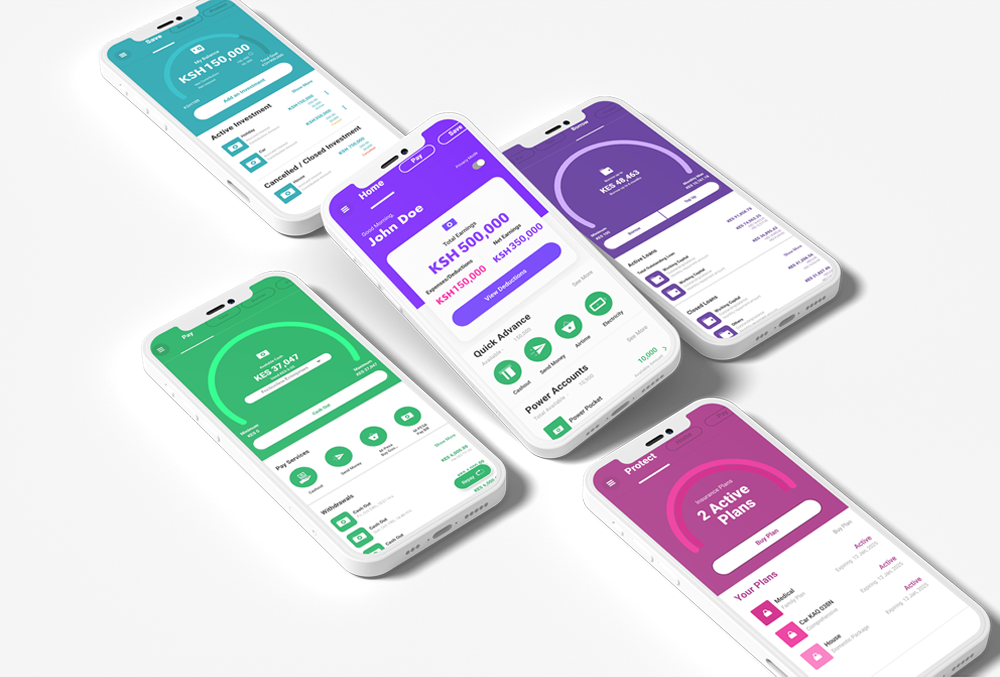
Power is a workplace banking platform. We work with employers, financial institutions, SACCOs and HR tech platforms to put salary advances, savings, responsible loans and insurance into the hands of workers through the payroll relationship that already exists.
Workers access services through an app or USSD. HR and Finance use a web portal to manage onboarding, set policy, and reconcile deductions.
We are licensed by the Central Bank of Kenya (Digital Credit Provider), the Insurance Regulatory Authority, and Uganda’s Ministry of Finance. Regulation is the difference between a salary advance that protects the worker and one that puts them deeper in a hole.
Why now
Two things have shifted at once.
Worker side: The cost-of-living squeeze across Africa has not let up. Food, transport, rent, school fees, healthcare- the line between “fine” and “one shock away from a problem” has thinned for millions in formal and informal sectors.
Our side: After several years in the market, Power runs across Kenya, Uganda, Rwanda and Zambia, with four products live- Pay, Save, Borrow, Protect – and a fifth, Power to Plan, coming. Our partners include Ecobank, Absa, Jubilee, Sanlam, Turaco, I&M Bank, Poste Finances and First Capital Bank, among others.
That is why we are reintroducing the brand now, with a sharper line: Workplace Banking, Simplified and a new website. A refresh, with the work and infrastructure behind it.

What changes, depending on who you are
Employers. The salary advance inbox stops. Workers borrow inside a regulated, transparent framework instead of from apps charging high interest. HR gets time back. Retention follows.
SACCOs and cooperatives. Member lending and savings digitised end-to-end — check-off automation, app and USSD access, clean utilisation views — without rebuilding core systems.
Banks and MFIs. Workplace banking is a new channel for customer acquisition, deposits and lower-risk lending. Power has built this infrastructure over the years. Choose how you want to play: white-label the stack, partner with us as lender of record, or use Power as your off-the-shelf core banking layer.
HR and payroll platforms. Plug Power in as the financial services layer of your platform without building, licensing, or carrying the risk yourself. Your product becomes more valuable to employers and staff signed onto your platform.
In short
Workers in Africa do not need more loan apps. They need financial services to manage cash, save, cover emergencies, and insure against shocks. When these are delivered through institutions they already trust through a solid platform, the month gets a lot easier for everyone.
Explore Power today. Book a demo.